Printable family unit
Jobs, Wages, and Work
A five day homeschool unit on labor force measures, unemployment, wages, purchasing power, skills, productivity, and job matching for ages 11 through 16.
24 pages5 lessons1 household
Download the free 5 page sample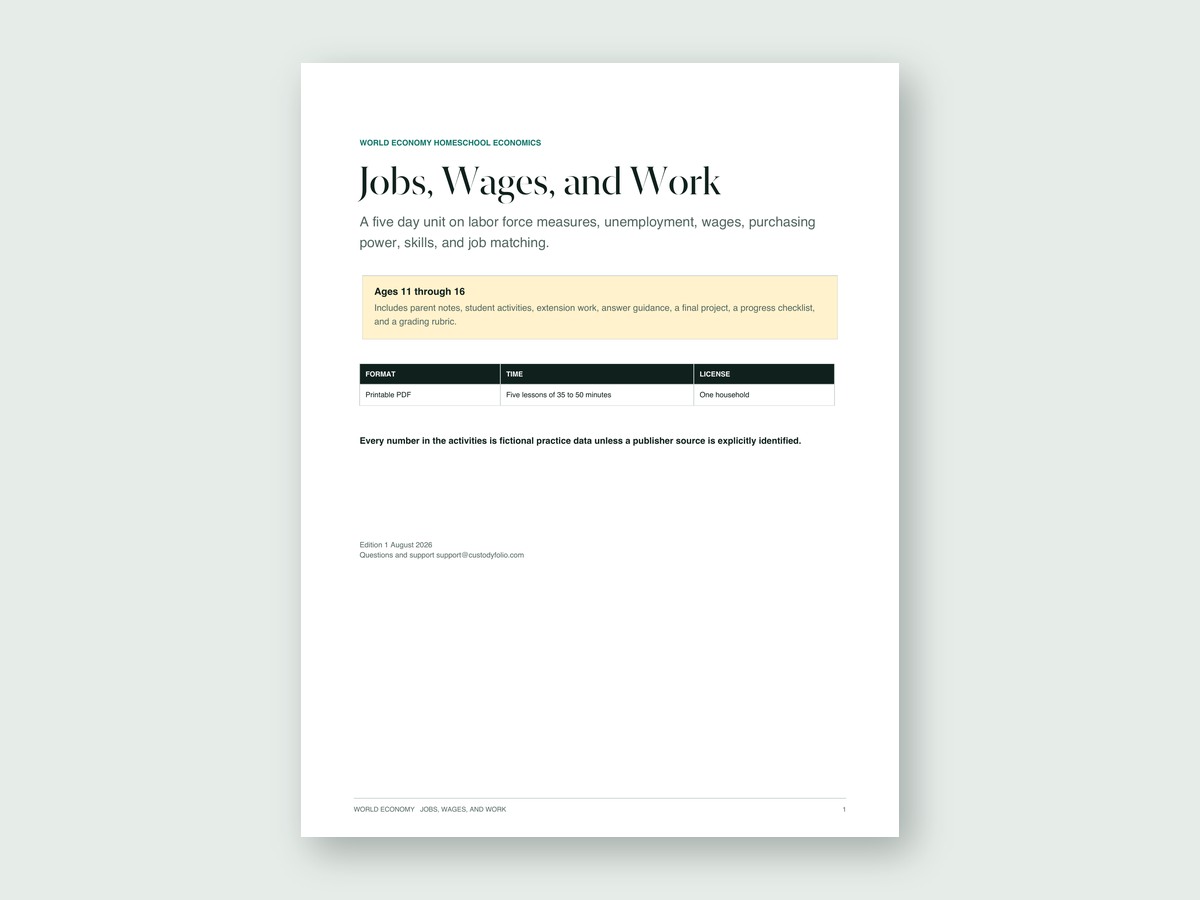
How can I teach unemployment, jobs, and wages?
Begin by classifying who is employed, unemployed, or outside the labor force. Calculate unemployment and participation rates from the same fictional community, then compare wage changes with price changes and discuss how skills, tools, location, and job matching affect opportunities.
Try the teaching approach freeInside the package
A finished unit, not a worksheet bundle
Core questions support younger students. Extension prompts add analysis for older students without requiring a separate purchase.
Student workbook pages
Core work for ages 11 through 13
Extension work for ages 14 through 16
Complete answer key
Final project and grading rubric
Downloadable household copy
Five day sequence
Each lesson builds toward a reasoned conclusion
All figures and households in the activities are fictional. Students can practice without disclosing private family finances.
Who is in the labor force
Classify fictional residents and explain why not every adult belongs in the labor force.
Calculate labor market rates
Calculate unemployment and participation rates from a consistent set of counts.
Wages and purchasing power
Compare wage changes with price changes to judge what a worker can buy.
Skills, productivity, and matching
Examine how training, tools, geography, and information shape work opportunities.
Write a community work briefing
Explain labor market evidence while naming uncertainty and measurement limits.
Know what to prepare before you choose.
Suggested starting session. Adjust the pace to your learners.
- Suggested audience
- 12–18
- Session length
- 30 minutes
- Prerequisites
- Multiply hours by pay and subtract expenses.
- Preparation
- 5 minutes: paper and a calculator.
Open the free teaching companion: activity, explained answers and next-week review →
The companion is a separate printable web resource. The pack’s PDF contents and license are listed on this page.
Preview the teaching approach
Calculate, then explain what the number means.
Students calculate labor market rates, compare nominal wages with purchasing power, examine productivity and matching, and explain what common measures leave out.
- No child account or personal profile
- No real household income questions
- No unsupported current claims
- Publisher sources for economic definitions
License and delivery
One purchase for one household
The household license lets you print copies for children who live in the purchasing household and keep a personal backup. Public posting, resale, and sharing outside the household are not included.
After Stripe confirms payment, a download link appears and remains valid for a short period. The saved PDF has no expiry mechanism, but you are responsible for keeping a private backup. Homeschool cooperatives can request a separate license from support@custodyfolio.com.
This is supplemental educational material, not an accredited course, standards certification, credit award, or guarantee of compliance with local homeschool requirements.
The PDF is visually structured, but may not expose complete PDF tags or reading order to every assistive technology. Review accessibility and request an alternative format before purchasing.
Read the Terms of Use and Purchase Terms